
Same process, new motor: what history says about the AI productivity paradox
Every few decades the same awkward question returns: if this technology is so important, why can't we see it in the productivity numbers? We are asking it of AI now.
I have been working in and around AI long enough that a lot of the current hype cycle feels familiar, but to find the best analogy for what is going wrong, I had to go back much further than my own career: to factories swapping steam for electricity.
Is it real? Where is the ROI?
Most organisations have now deployed something: triaging emails, a chat system for internal documents, meeting summaries, etc.
The technology is visible everywhere, yet when the CFO asks what changed in the numbers, the honest answer is often "not much yet". Cue the sceptical commentary: the returns aren't there, the bubble is deflating, it was overhyped all along.
But we've run this exact argument before. Back in 1987, economist Robert Solow put it bluntly: "you can see the computer age everywhere but in the productivity statistics". The same gap keeps resurfacing:
- Electrification took decades to show up in manufacturing productivity.
- Economists asked the same question of AI years before ChatGPT made it a hot topic.
Each time the pattern is the same: obvious excitement, confusing macro numbers, confident declarations of failure.
And each time, the eventual answer was not "the technology failed" but "the reorganisation hadn't happened yet". That is the uncomfortable part for anyone deploying AI today: most companies have not finished reorganising. If we are really honest, most have not really started.
Group drive and unit drive
Credit has to go to the economist Paul David, who told the definitive version of this story in 1990, when the same puzzle was still being asked of computers (back when they were starting to become mainstream), and he went looking for a precedent. He found one in the electric dynamo.
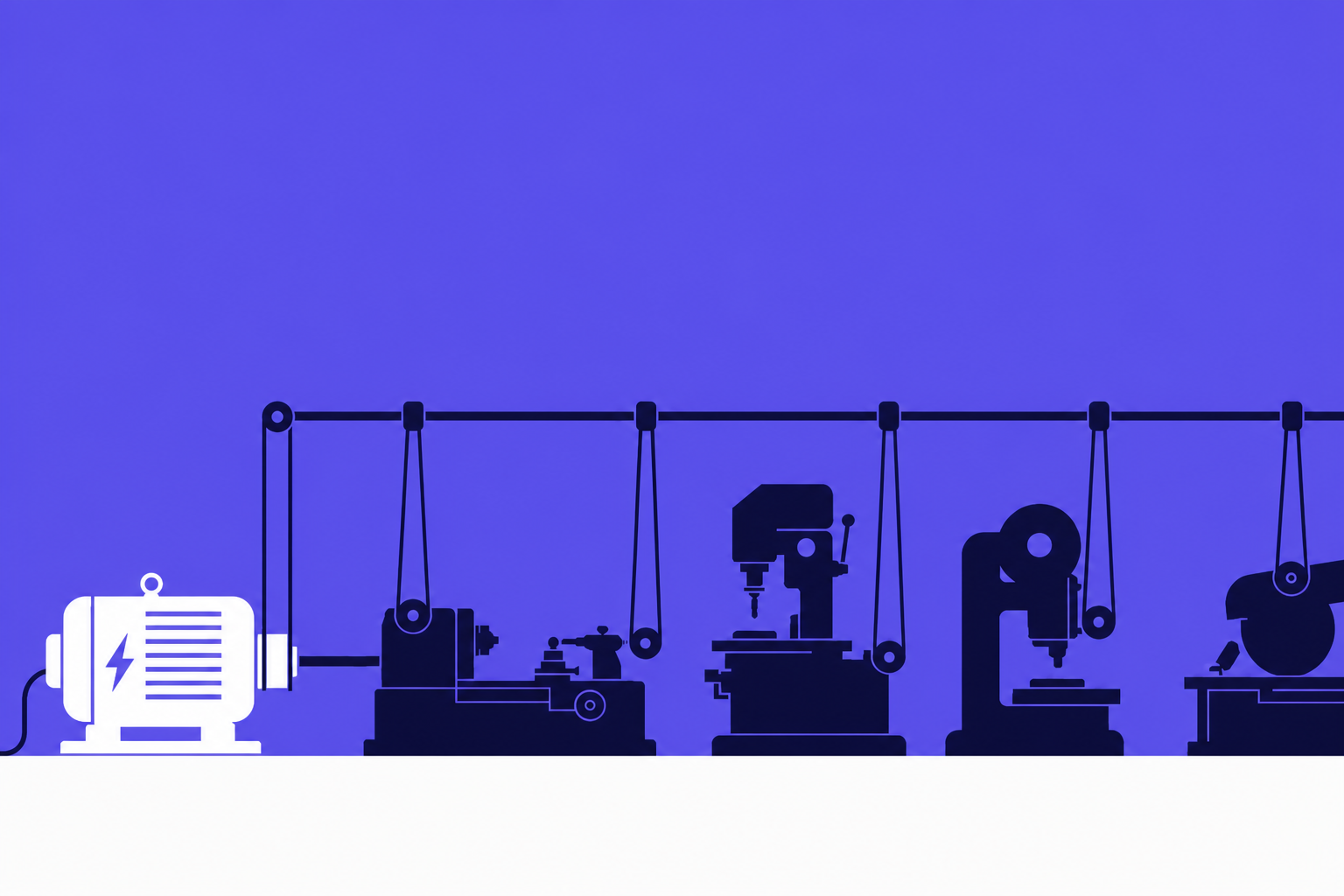
A late nineteenth-century factory was built around one enormous steam engine. Power ran through a central line shaft the length of the building, and every machine hung off that shaft through belts and pulleys. The entire factory layout was dictated by the reach of the belts, not by the flow of the work.
When electricity arrived, the first move was the obvious one: rip out the steam engine and bolt a single large electric motor in its place. Historians call this group drive. Same shaft, same belts, same layout, same workflow. The productivity gain was modest, and plenty of factory owners concluded electricity was overrated.
The real gains came from unit drive: a small motor on every machine. Once each machine had its own power, the line shaft could go, and the factory floor could be rearranged around the sequence of the work itself. As a consequence the layouts became flexible, and output per worker climbed. But that step took decades: it needed new plant designs, new skills, and new management practice, not just new hardware.
More recently (in 2019) David's point was extended to AI by Erik Brynjolfsson and colleagues, that general-purpose technologies pay off in two stages: substitution first, reorganisation later, with a long and confusing lag while the complementary investments catch up.
I have spent more than twenty years working in AI, and I find it mildly deflating that the most useful mental model for my industry's current predicament comes from 1890s factory engineering.
Replicating the human workflow
The majority of AI use in organisations today still replicates the existing human workflow, step for step, in much the same way the first electric factories simply replicated their steam-era layout. A model now assists at each step, but the sequence, the handoffs and the sign-off chain are unchanged.
That was the default in the first wave of AI deployments, and for most organisations it still is.
This is group drive in a different form: a new motor bolted onto the old line shaft.
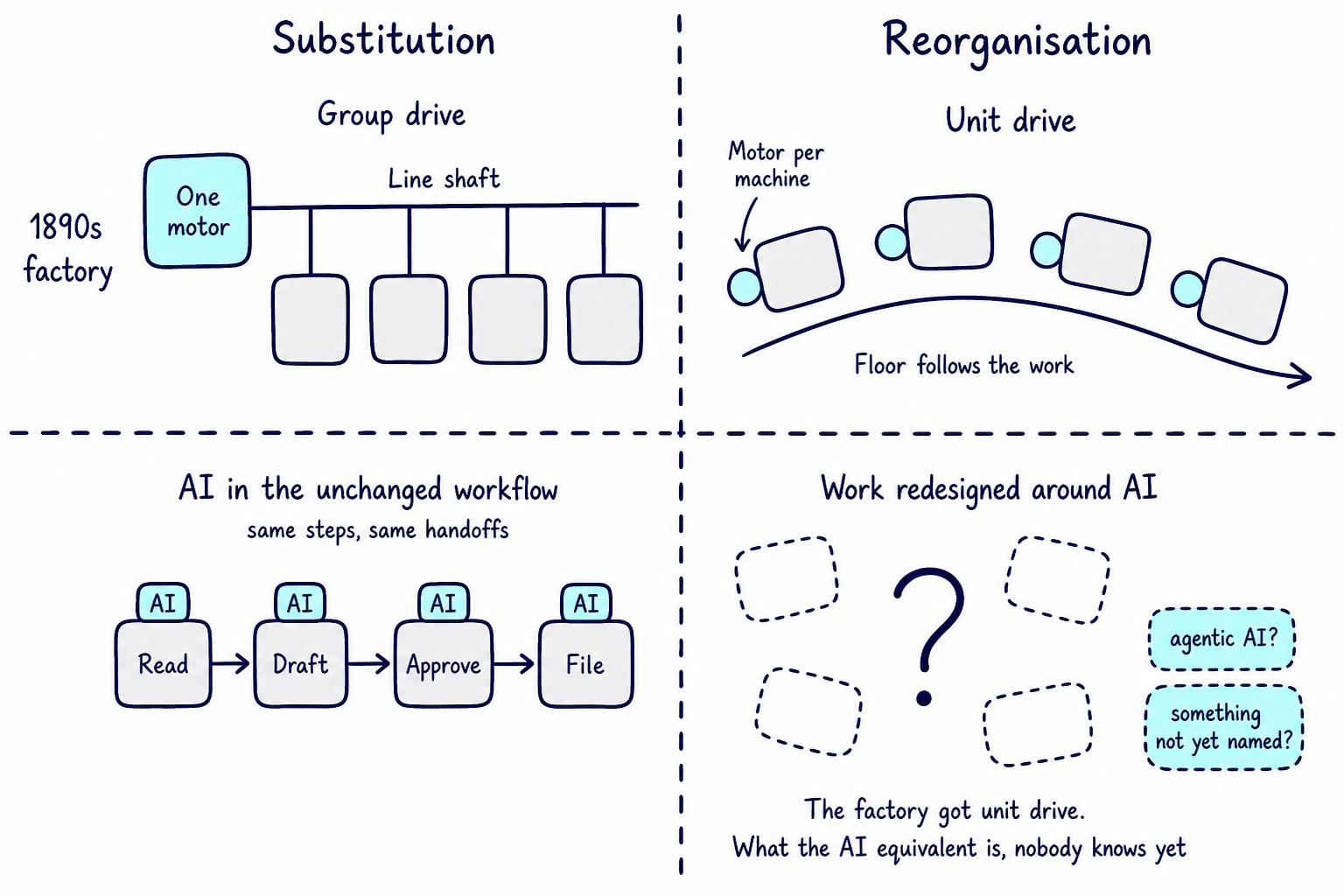
Figure 1: The factory's reorganisation is history; the AI equivalent is still unknown.
I want to be fair about why this happens, because it is not laziness or stupidity. It is mostly rational.
- Money. Reorganising how work flows costs real capital and real opportunity cost. Substitution is cheaper on the spreadsheet, and let's face it, the spreadsheet usually wins.
- Transformation is genuinely hard. Clayton Christensen wrote The Innovator's Dilemma on the observation that competent incumbents struggle to cannibalise what already works. That was never only about technology firms.
- The operational treadmill. In large companies especially, near-term delivery consumes almost all organisational energy. Nobody has the slack to redesign the factory floor while the current line is running flat out.
- The incremental instinct. A proven process plus a better motor feels low-risk. If it ain't broke, why fix it... let alone redesign it? The 1900s factory owner reasoned the same way.
With all this in the mix it is no wonder that the standard business surveys keep finding:
- Isolated pilots that never connect to one another
- Proof-of-concepts that quietly die once the demo is over
- Success measured by adoption (licences issued, prompts sent) rather than any real business outcome
Analyst estimates put the share of AI pilots that never reach full-scale deployment at close to 90%. And since every competitor can buy the same models, the advantage is not in the model: it is in the reorganisation.
Bolt AI into the unchanged process and you have simply added a checking step to every task, without making the checker's job any easier. Redesign around the reviewer, treating their attention as the scarce resource, and the same technology starts to show its value.
Just to be clear, when I talk about redesigning work for AI, it does not necessarily mean removing humans from it. Where a human stays in the loop (and in most serious deployments one should), redesign means optimising for that loop. That means redesigning:
- What the reviewer needs to see
- How fast they can see it
- Where their judgement actually adds value
Agents, and a glimpse of the frontier
Most of what I have described so far is AI assisting a single step a human was already performing. While at the more advanced end of what is happening right now sits agentic AI: systems you delegate work to, which use tools, take multiple steps on your behalf, and come back with a finished artefact. This essentially shifts things from "answer my question" to "do this package of work and I will review it".
Again, the human does not disappear; their role becomes more explicit: judgement, integration, accountability, sign-off.
We can already glimpse what this looks like: OpenAI researchers recently published behavioural data on how their coding agent is actually used (Johnston et al., 2026): delegation of substantial, multi-hour tasks grew roughly tenfold in the first half of 2026, and inside the company itself, usage has shifted almost entirely from chat-style assistance to delegated agent work.
While that is genuinely impressive, it also comes with caveats:
- The study is vendor-authored
- The users are experts in using AI
- They are working with far fewer legacy constraints than many organisations (particularly large enterprise companies)
- The metrics measure output rather than value.
So I would describe this as a glimpse of a possible future, not a definitive template.
To be careful with the analogy: I am not claiming agentic AI is the unit drive of this story. What we can say is that an agent wired into an unchanged workflow is still a bolt-on, just a more capable one.
We might still be in the steam era
A further dose of humility: the first "electric factories" mostly kept their steam-era layouts too, and nobody at the time thought of themselves as still living in the steam era. If the analogy holds, today's most advanced agentic patterns (delegation, parallel runs, encoded skills) may themselves be an equivalent we haven't recognised yet: a smarter motor on a line shaft we haven't noticed we're still using.
The people who eventually invented unit drive were not the ones who electrified first; they were the ones who stopped assuming the line shaft. Something similar may happen here: people who grow up delegating to agents may organise work in ways that make 2026 patterns look quaint: new interfaces, agent-to-agent coordination, or organisational forms nobody has named yet.
While I am confident about the direction; I would not sign my name to the exact destination as yet. But even with the destination uncertain, one thing is already clear: that whatever it turns out to be will make judgement and governance a key part of the process.
What reorganisation won't remove
The electrification story has a sharp footnote here. Early unit-drive factories, having reorganised production, found their next constraint at inspection and packing: steps that stayed manual because they needed a person's judgement, not because anyone had simply failed to automate them yet. Whatever AI's own reorganisation turns out to look like, it will hit the same kind of wall, for the same reason:
- A clinical decision still needs a clinician's sign-off
- A contract still needs a lawyer
- An engineering change still needs someone accountable
That judgement stays fixed even as output climbs, so when agents run in parallel, fifty times the drafts can simply mean fifty times the review queue if nothing else changes. It is also why activity metrics are such an easy trap: tokens generated, agents deployed, drafts produced can all climb impressively while judgement stays exactly where it was, and none of that climbing is business value.
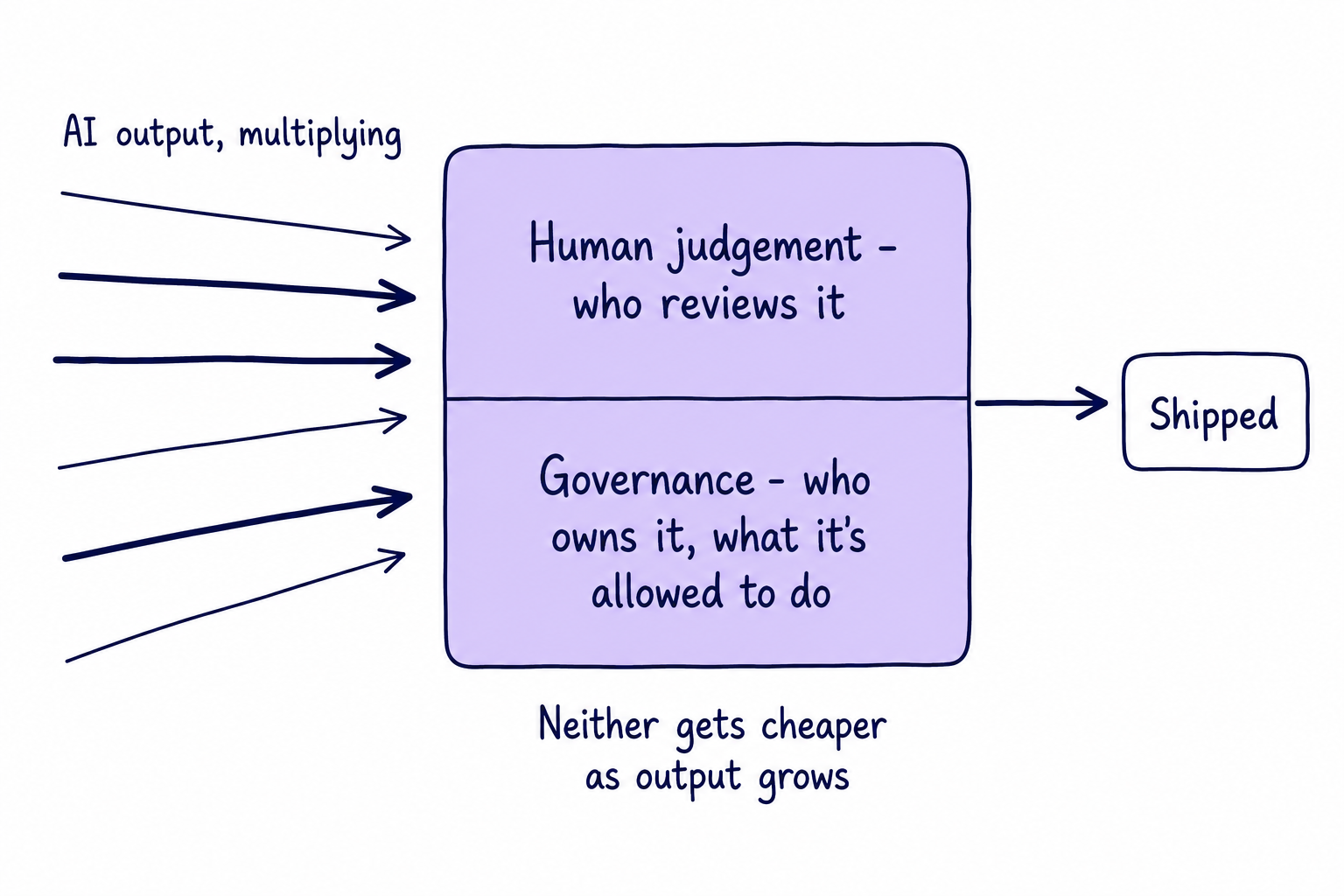
Figure 2: Output can multiply freely. Judgement and governance do not.
Judgement, accountability, and integration with real systems and real policy do not get cheaper just because drafting did, and that is not a gap to be engineered out. Reorganisation and governance are really the same conversation: you cannot delegate work at any serious scale without someone owning what the system is allowed to do, and someone reviewing what it produces.
Are you still on group drive?
Three questions should tell you where you are:
- Are you substituting or reorganising? Is AI doing the same steps faster, or has anyone redesigned the steps?
- Do your pilots compound or stay isolated? Pilots that never touch each other add up to nothing more than a faster version of the same process, however many of them you run. That is still group drive, whatever the project is called.
- Who owns review when work is delegated? If nobody can answer, you are not ready to delegate at scale, whatever the tooling says.
Software should move faster than factories did, since nobody has to pour new concrete, but faster than forty years is still not the same as next quarter. History suggests the winners will not be whoever has the better motor, but whoever successfully redesigns the factory floor.
If you are looking for some help in assessing where your own organisation sits on that spectrum, and what redesigning around it might look like, get in touch.
References
- Solow, R., "You can see the computer age everywhere but in the productivity statistics," New York Times Book Review, 12 July 1987.
- David, P. A., "The Dynamo and the Computer: An Historical Perspective on the Modern Productivity Paradox," American Economic Review, 80(2), 1990.
- Brynjolfsson, E., Rock, D. and Syverson, C., "Artificial Intelligence and the Modern Productivity Paradox," in The Economics of Artificial Intelligence: An Agenda, AEA Papers and Proceedings, 2019.
- Christensen, C. M., The Innovator's Dilemma: When New Technologies Cause Great Firms to Fail, Harvard Business Review Press, 1997.
- Johnston, D., Holtz, D., Richmond, A. M., Ong, C., Tambe, P. and Chatterji, A., "The Shift to Agentic AI: Evidence from Codex," arXiv:2606.26959, 2026. https://arxiv.org/abs/2606.26959