
Why you shouldn't ask a language model to do your sums
Generative AI is only one part of AI, and it isn't always the right part for the job
In September, OpenAI announced that its AI agents had resolved one of the Millennium Prize Problems, a small set of famously hard maths problems that each carry a $1 million prize. Yet a few weeks earlier, a research paper had found that a top language model, given an ordinary table of data, made worse predictions than statistical methods that have been around for decades. So how can AI be good enough at maths to take on one of the hardest problems there is, and still struggle with a table of data?
The difference comes down to how AI was used in each case:
- The paper tested a language model on its own, with no tools
- The proof took a great deal more than a language model
For me, this matters well beyond whether an AI model can do maths. Over the last few years, "AI" has become shorthand for generative AI, and when people think about using AI for a task, a chatbot is usually the first thing they reach for. But generative AI is only one part of AI, and there are areas (working with numbers being a good example) where it isn't really suited to doing the work on its own.
In this article I want to look at why that is, at the other kinds of AI (and non-AI approaches) that suit this kind of work better, and at how they can be combined into something you can rely on.
Which AI?
Generative AI tools like ChatGPT, Claude or Copilot, where you type a question and get a written answer back, are built on large language models (LLMs), which are trained to produce text. Many of the approaches that work with numbers are quite different (predictive models, statistics and data science more generally), and they have been used in businesses for decades, for things like forecasting demand, scoring credit applications or setting prices. I went through some of these approaches in a recent post, Is AI good enough yet?, so I won't repeat them here.
These approaches also go wrong in different ways. A forecasting model can be wrong too, but how far wrong it tends to be can be measured and tested before anyone becomes reliant on it, whereas a language model's mistakes with numbers are hard to predict and look just like its correct answers.
Microsoft are fairly upfront about this with their own tool. The help page for Copilot in Excel says it "can sometimes make mistakes, misinterpret information, or produce inaccurate results", and advises against relying on it for "decisions in sensitive areas such as finance".
Can you trust it with a sum?
The simplest way to put it is that language models aren't built for maths, or at least not for the calculating side of it (I'll come back to the Millennium Prize result later). Knowing how they work, that doesn't surprise me, but I think it's worth spelling out, because a lot of people now use these tools for exactly this purpose.
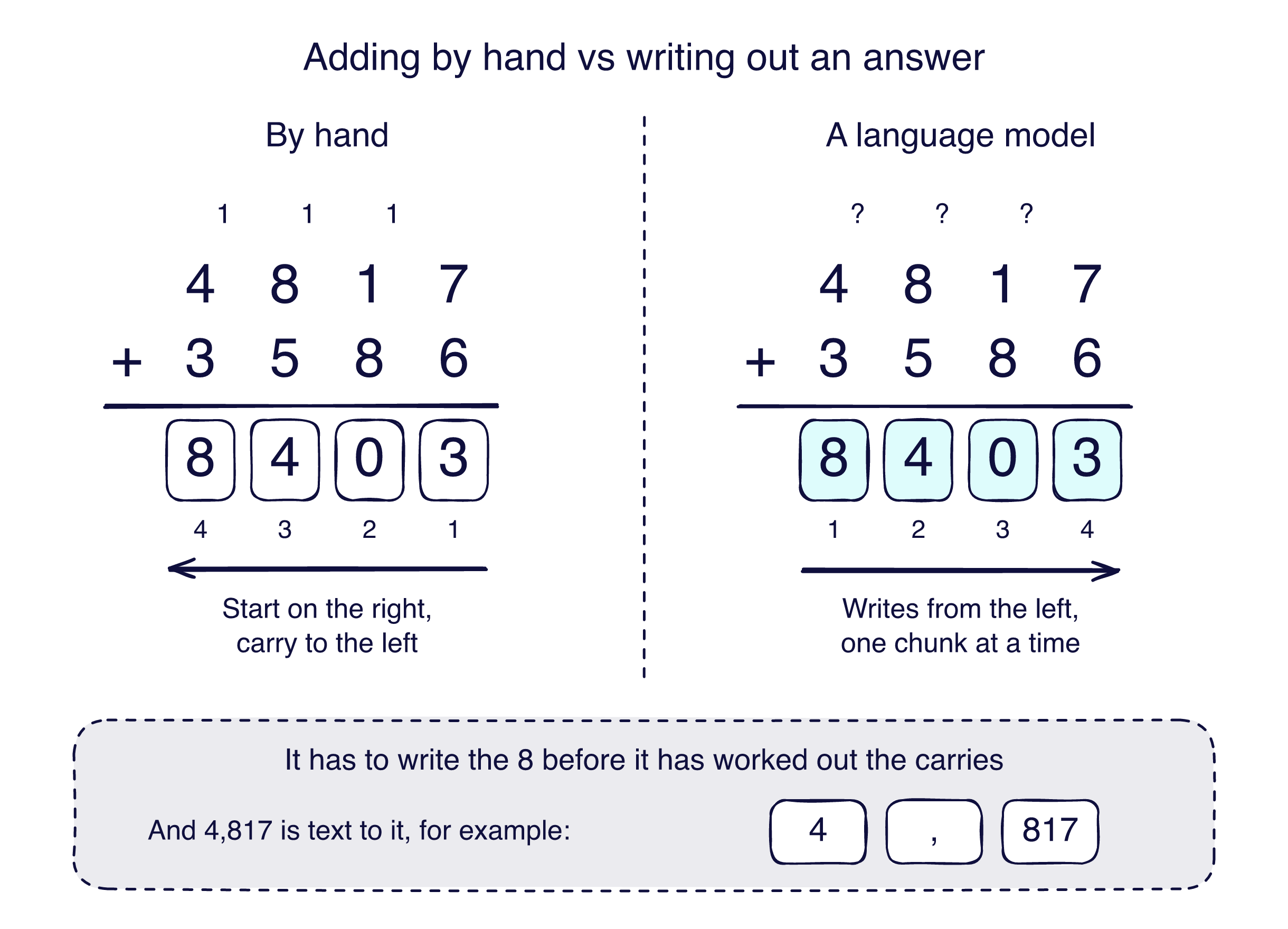
A language model doesn't calculate anything in the way a calculator or a spreadsheet does: it writes its answer one small chunk of text at a time, predicting each chunk from what came before, so a number like 4,817 is just a few chunks of text to it rather than a quantity. It also writes from left to right. When we add two numbers by hand, we start from the right and carry to the left, but a language model has to write the first digits of the answer before it has worked through the later columns (Figure 1), which is one reason long additions tend to go wrong somewhere in the middle.
And it's easy to see why people use them for it:
- They're so easy and natural to use (which is one of their great strengths)
- The chat window is usually already open
- The answer nearly always looks reasonable
- They're often marketed as being able to do it
The models have improved a lot, and some of the well-known questions that used to catch them out now get answered correctly: once a failure becomes famous, it tends to get fixed. That's good, but it also means the mistakes that are left are rarer and harder to spot.
Figure 2 shows one of these models getting a simple sum wrong. It's one four-digit number multiplied by another: the kind of long multiplication children learn at primary school, and something any calculator does perfectly, so you'd fully expect one of the latest models to get it right. I asked it in a fresh session with Claude Sonnet 5.5 (one of Anthropic's latest models), with thinking switched on (the step-by-step reasoning some models do before they answer). Both intermediate steps of its working are correct, but when it added them together it got 5,901,164, when the right answer is 5,900,564 (out by 600), with nothing to suggest it might be wrong.
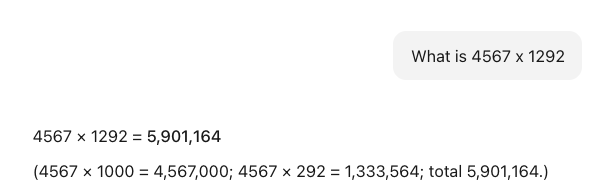
Most people wouldn't expect a wrong answer here, and I suspect most wouldn't spot it either. Nobody double-checks a calculator (I certainly don't), and I think people treat answers from these tools in much the same way: the answer comes back looking confident, with its working shown, so it gets used.
For a quick personal calculation that error may not matter much, but for any decision with real consequences, trusting a language model the way you'd trust a calculator is dangerous. And if a model can fail this clearly on something this simple (even with thinking on), it should make us question how reliably it handles more complex analytical work, where the mistakes would be far harder to spot.
To check this more systematically, I asked the same question 20 times through the API (the direct way to connect to the model, without the chat app), and it got it right every time. I also wanted to see whether switching its thinking off changed anything, but when told to reply with just the number, it worked the sum out step by step anyway.
So those 20 correct answers don't show how it does without working the sum out, because it wouldn't do that. They do show that it usually gets this sum right, and the run in Figure 2 shows that it sometimes doesn't, with no way of telling in advance which you'll get.
The next step was to go a level deeper and see how much worse it gets when a model has to answer straight away, without any thinking. These tests aren't meant to be a rigorous benchmark: they're a handful of deliberately simple examples (the sort of thing a ten-year-old could do with a pen and paper) to show what this looks like in practice. Since Claude wouldn't skip the working, I ran them on OpenAI's models through OpenRouter (a service that lets you send requests to models from different providers), which made it easy to put exactly the same questions to four different models:
- GPT-6.1 Sol, one of the more capable models in OpenAI's current range
- GPT-6.1 Terra, a cheaper, mid-tier current model
- GPT-5.5, the previous generation
- ChatGPT's current Instant model (the fast model ChatGPT uses for quick answers, which OpenAI makes available to developers as
chat-latest)
Every question ended with "Reply with just the number, nothing else", and each model's reasoning was switched off. Unlike Claude, these models mostly did as they were told. The exceptions were GPT-6.1 Sol, which won't let you switch its reasoning off completely, so it ran on the lowest setting available, and the Instant model, which still did some reasoning on the invoice questions. There were three sets of tests.
Multiplication. I asked each model 26 different four-digit multiplications (including 4567 × 1292), repeated to make 120 questions per model. With reasoning off, the other three models got between 38 and 60% of them wrong, and the Instant model answered 4567 × 1292 with 5,901,164, exactly the same wrong answer as in Figure 2 (and with 5,900,964 and 5,900,764 on other runs). The wrong answers were usually right at the start and the end and wrong in the middle (48,174,116 instead of 48,194,116, for example), so nothing about them looked wrong.
Adding up invoices. I gave each model a list of 80 made-up invoice amounts, of between about €15 and €4,800, and asked for the total, ten times each. GPT-6.1 Terra and GPT-5.5 got it wrong every time, by anything from about €300 to €17,600, and GPT-5.5's total was too high on every run. Asked how many of those invoices were over €1,000 (a simple count), GPT-5.5 got that wrong every time as well.
Puzzles. I also tried two well-known questions that used to catch models out: how many r's there are in "strawberry" (three), and which is bigger, 9.11 or 9.9 (9.9). All four models got both right every time. I then tried two close relatives that are much less famous. The first was the same question about "cranberry" (also three r's), and GPT-5.5 said two in 4 out of 10 runs. The second was a stripped-down version of the classic river-crossing puzzle (usually a farmer, a wolf, a goat and a cabbage, which takes several trips). My version just asked: "A man has to get a chicken across a river. His boat can carry him and the chicken. How many trips does he need?" The answer is one, but the Instant model said two in 7 out of 10 runs. So a famous example being fixed doesn't mean a similar one has been, and the "raw" language model turns out to be quite brittle once you step away from the questions everyone knows.
GPT-6.1 Sol, running with only a small amount of reasoning, got 119 of the 120 multiplications right, and every invoice question. So with reasoning the mistakes become rarer, as with Claude, but they don't go away, and whether you get the right answer depends on which model you're using, settings you often can't see, and to some extent chance. With thinking on or off, you can't trust these models to get this kind of thing right every time (and this is very basic maths).
Real business cases involve far more data and more complicated calculations, so there is more room for something to go wrong, and in some cases a mistake costs far more.
The key point I am trying to make is that any calculation that runs thousands of times will eventually hit one of these failures, and we have no way of telling which run it was. Whereas a spreadsheet, a calculator, or a few lines of code gets the right answer every time.
What happens when you give it a table?
My examples are deliberately trivial, so the obvious next question is how language models cope with the kind of analytical work a business would want help with. A research paper published in August looked at that far more systematically, on a more complex task: prediction from tables of data. That's the kind of thing a business might do with its past customer records (one row per customer, with columns for things like how long they've been a customer and how much they spend) to predict which current customers are likely to leave.
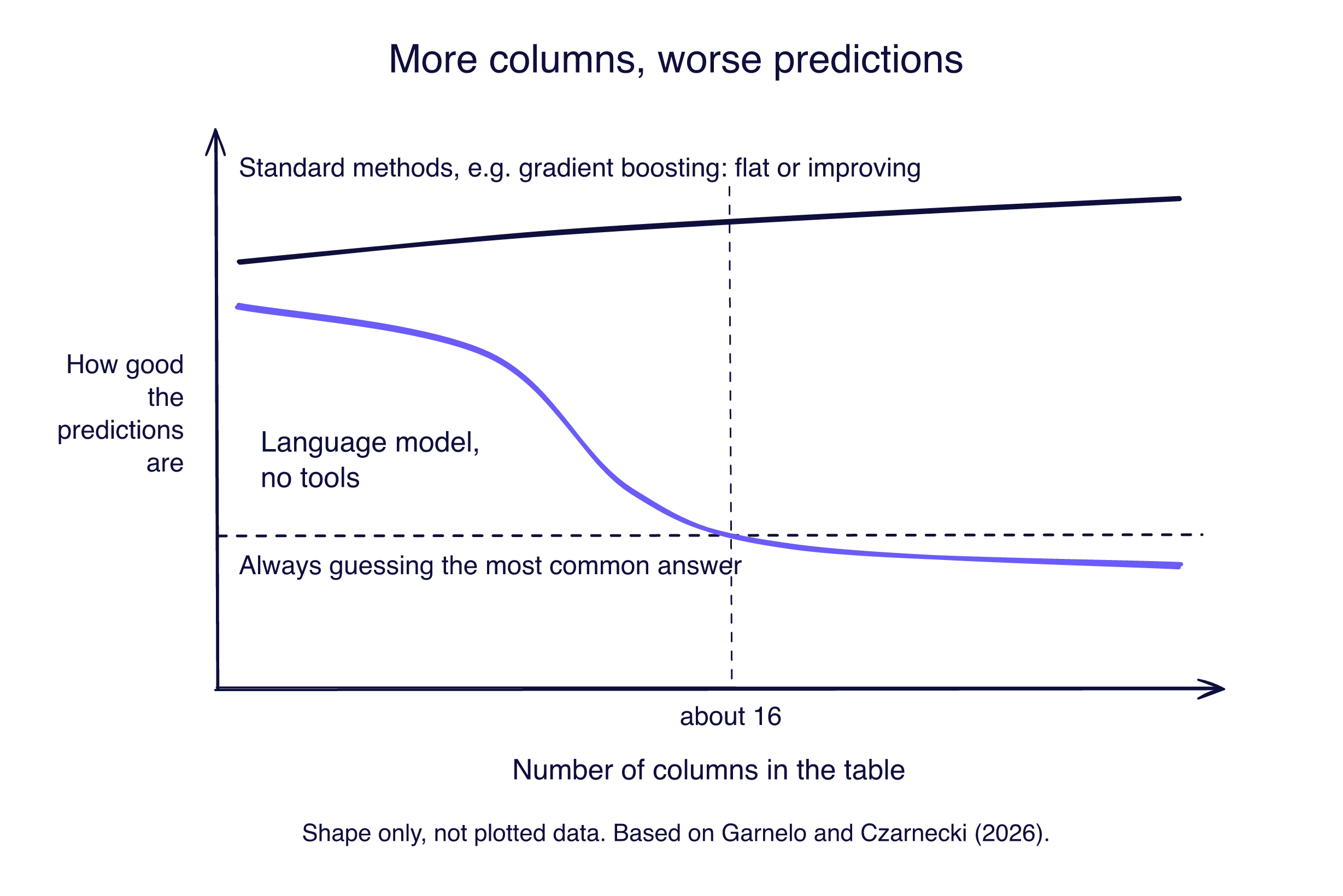
The authors, Marta Garnelo and Wojciech Czarnecki, gave a top language model (Claude Opus 4.6) tables of data and asked it to make predictions, with no tools, and compared it with eight standard methods that data scientists have used for decades (including gradient boosting, random forests and logistic regression). The results weren't good for the language model:
- It was the only method that got worse as more columns were added (Figure 3), and from about 16 columns onwards it did no better than guessing the most common answer every time, on most of the datasets.
- The researchers checked whether the problem was the format of the data, how precise the numbers were, or how many predictions it was asked to make at once, and none of these explained it. So a better prompt is unlikely to fix it, and their advice is that "purpose-built tabular models remain the right tool".
- It's also expensive: a table with 100,000 rows and 20 columns would need about 16 million tokens (the chunks of text a model reads) of input for each question, for an answer gradient boosting could produce on a laptop.
The model wasn't allowed to use any tools, though. If it had been, it would have written some code to fit one of those standard methods instead. So for prediction from a table, the right part of AI is one of the methods built for it, and the language model is far more useful writing the code to run it than making the predictions itself.
So what did the Millennium Prize result actually take?
Which brings us back to the opening question. On 8 September, OpenAI announced that its agents had found a "blow-up" in the Navier-Stokes equations, which describe how fluids such as water and air flow: a point where the solution to the equations breaks down. Whether that can happen is one of the Millennium Prize Problems. It's a genuinely impressive result, although the claim is a bit more careful than some of the headlines: OpenAI says it resolved two of the four statements the prize requires, it isn't claiming the prize money, and the Clay Mathematics Institute (which runs the prize) has described the problem as only "apparently" settled.
It also took a lot more than typing a question into a chatbot (Figure 4). Around 10,000 AI agents ran for 88 hours, which OpenAI has put at several million dollars and the BBC estimated at around $10m at OpenAI's own prices. That figure only covers the computing: it doesn't include the researchers who chose the problem, designed the setup, ran it and checked what came out, or the cost of training the model it used. And then there was the checking: about 17 hours later, a separate model had converted the proof into a form a computer can check, and mathematicians are still going through it.
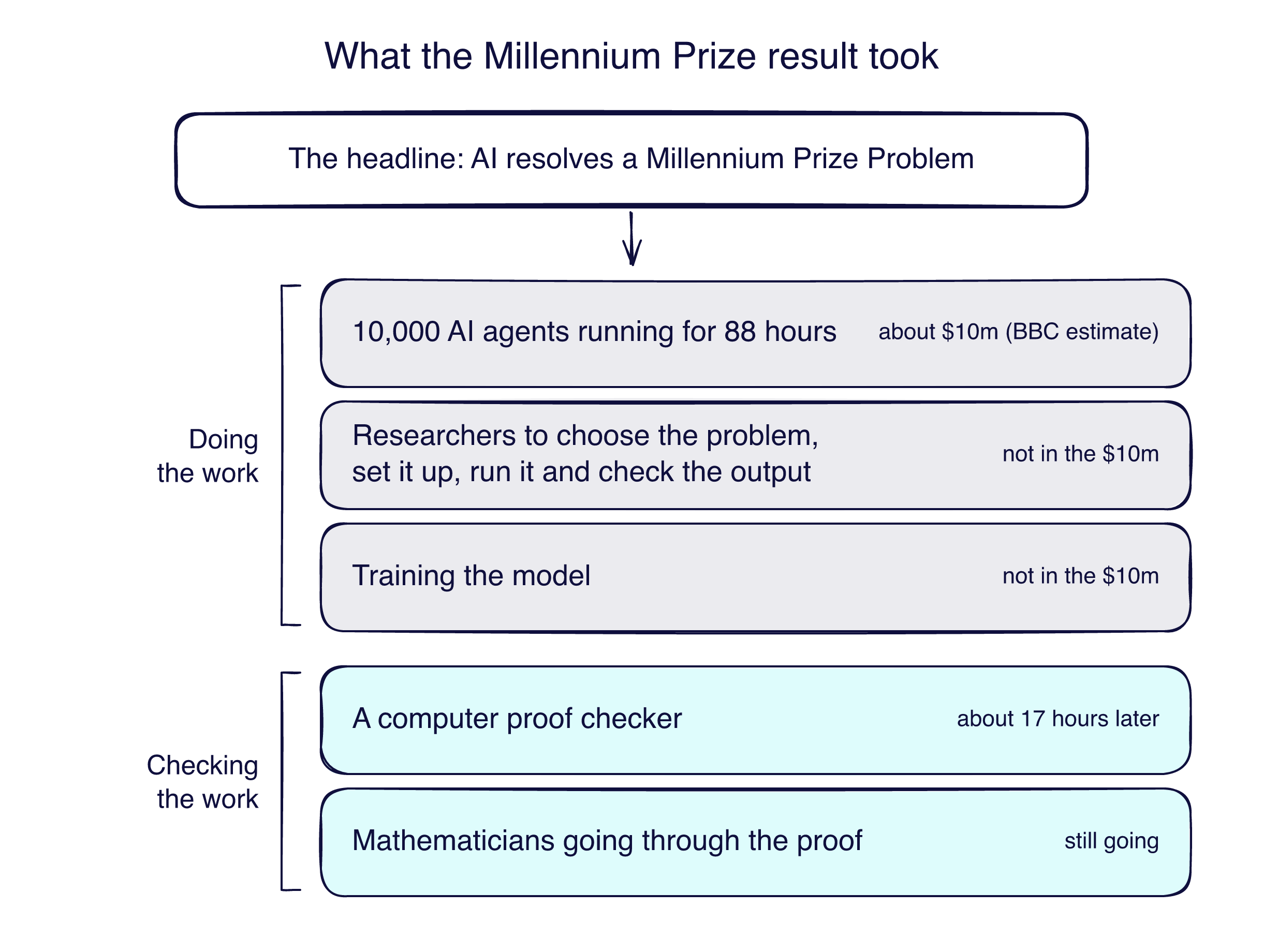
So how can the same kind of technology help resolve a Millennium Prize Problem, and also get the total of 80 invoices wrong, or do no better than guessing on a table of data? I think there are two main reasons:
- They're very different kinds of maths. A proof is mostly a chain of reasoning, written out in words and mathematical symbols, and working with that kind of text is what a language model is built for. Adding up a column of figures, or finding patterns across 100,000 rows of data, is a different kind of task: every number has to be handled exactly, every time, and as the tests above showed, a language model doesn't do that reliably on its own.
- The proof had checks built in. A separate model converted it into a form a computer could verify step by step, and expert mathematicians are going through it before anyone relies on it.
When you ask a chatbot a question about your spreadsheet, nothing like that happens, and unless you check the answer yourself, nobody does. The Millennium Prize result came from a language model combined with other pieces that could catch its mistakes (a computer proof checker, and people who knew what they were looking at), which is the point I made at the start.
Can you trust the explanation?
When a language model explains how it got an answer, the explanation isn't a reliable record of what it actually did. Figure 2 already shows this on a small scale: each step of the working was correct, but the final answer didn't follow from it, so the working gives the impression the answer was checked when it wasn't.
The tabular paper tested this more directly. After the model had made its predictions, the researchers asked it to explain the rule it had used. In 14 of the 20 tasks the explanation didn't match the data, and that included 4 where the prediction itself was right but the reason given for it was wrong.
So an explanation from a language model tells you how it might have reached an answer, written after the fact, rather than how it actually got there. If you need to show how a figure was worked out, you need the calculation itself: the query, the code, or the model and the data that went into it.
Who should do the sums?
Language models are still useful when it comes to numbers. They're very good at the work around them: understanding a loosely worded question, turning it into a database query or some code, and explaining the results in plain English. Where the information comes in a less structured form (emails, contracts, PDFs or free-text notes), a language model is often the best tool for pulling the figures out in the first place.
For the calculations themselves, though, a reliable system will usually combine a few different technologies, using tools that give the same answer every time:
- Arithmetic and totals: a database, or a few lines of code.
- Predictions from a table: gradient boosting, or one of the newer models designed for tables.
- Forecasts over time: established forecasting methods.
It's a similar split to the one in my recent post on decision models, where some checks (such as whether a payment is within a defined limit) are exact and belong in standard software.
When is it worth building something properly?
Setting up a system like that takes more work than opening a chatbot, so whether it's justified depends mainly on two things: how often the task runs, and what happens when it goes wrong (Figure 5).
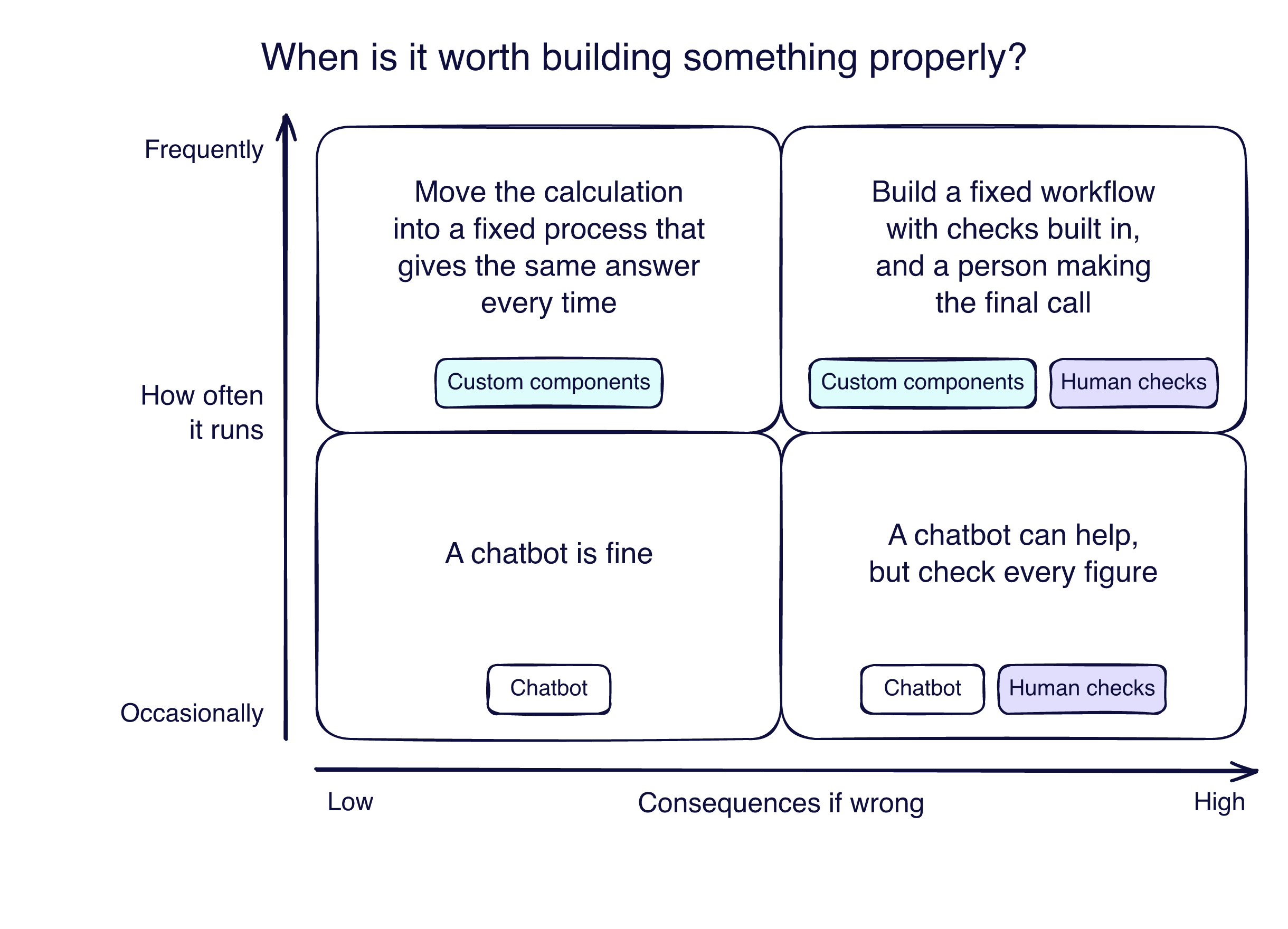
Using ChatGPT, Claude or Copilot to check your own spreadsheet sits in the bottom-left, and there it's fine to accept the limitations of these models. Moving to the right, the higher the consequences, the more checking a person needs to do: a chatbot can still help with an occasional question, but someone should check every figure, ideally with it running code you can see. Moving up, the more often a task runs, the more small errors add up, so it's worth moving the calculation into custom components that give the same answer every time, rather than leaving a language model to do it in a way that might come out differently each time. In the top-right, where a task runs frequently and mistakes matter, you need both: a fixed workflow with checks built in, and a person making the final call.
As an example, take a finance team that wants to know why gross margin fell last quarter. If they pasted the data into a chatbot they would get an answer, but there's no way of telling which figures had been calculated, or whether the reason it gave came from the data at all. A safer version splits the job up:
- The language model turns the question into a database query (for example, margin by product, region and month).
- The database does the arithmetic.
- A standard statistical check or forecasting model shows whether the drop is outside the normal range, and which products are driving it.
- Simple automated checks confirm the figures hold together (for example, that the totals match the finance system) before anything is reported.
- The language model then writes the explanation using only the numbers it has been given, with the query alongside it so anyone can check where the figures came from.
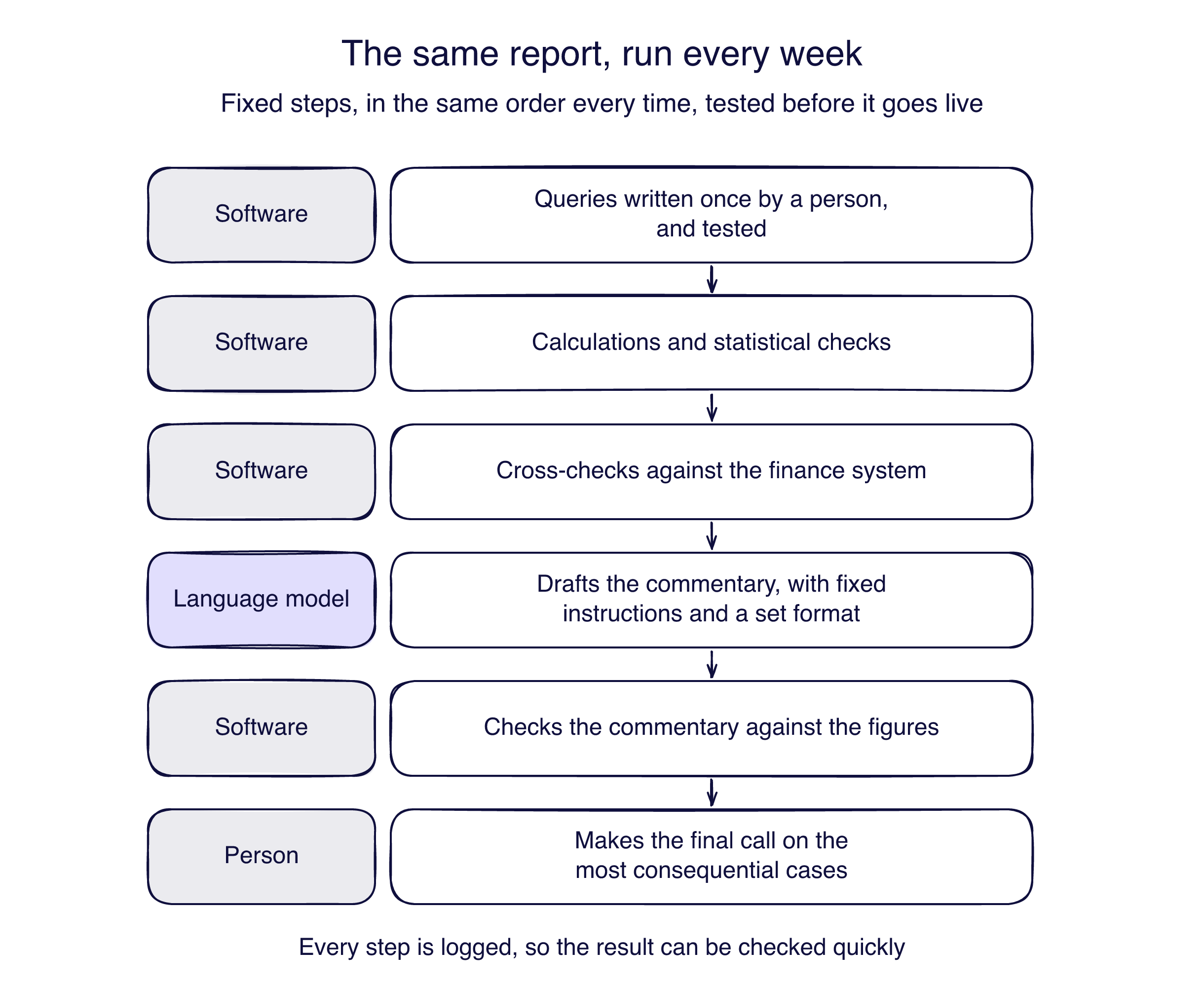
That works well for a one-off question, where nobody knows in advance exactly what will be asked. But if the same analysis is run every week as a standard report, it moves into the top-right of the grid, and I'd take the language model out of most of those steps (Figure 6):
- The queries are written once by a person and tested, rather than generated by a language model each time.
- The calculations, statistical checks and cross-checks are built into fixed components that run in the same order every time.
- Where a language model is still useful (for example, drafting the commentary), it's used in a much more constrained way, with fixed instructions and a set format, and its output is checked against the figures before anything goes out.
In some cases the language model isn't needed at all. This is what I called a predefined workflow in my post on agents: the steps are specified in advance in software rather than chosen by the model, which suits work that follows the same pattern each time.
In both versions, the checks are what make the result reliable: cross-referencing figures against each other and against the source data, and deterministic checks (rules in standard software that give the same result every time) to catch any figure the language model has made up. For the most consequential uses, a person should still make the final decision. The system can support them by keeping a full audit trail of the data used and the decisions made along the way, so that checking the result is much quicker than doing the work themselves. And because the steps are fixed, the whole thing can be tested and tuned before it goes live.
When a chatbot gets numbers like these wrong, it often gets written off as "AI slop" and the idea gets dropped, when it was being used for a job it wasn't designed for. Building the top-right kind of system takes some knowledge of these different areas of AI, and usually some setup for the specific case, and that's a large part of what I do.
What if you're just handed a number?
For the occasional figure that came from a chatbot, a few quick checks can help:
- Can you see the query or code behind the number? If not, assume it was written rather than calculated.
- If you ask the same question twice in a fresh chat, do you get the same answer?
- Have you checked at least one of the figures yourself?
- For a forecast, does it do better than a simple baseline, such as last year's figure?
- Is the explanation backed up by the calculation, or just sitting alongside it?
These are for the bottom row of the grid, where a chatbot is doing the work, and they matter most on the right, where the consequences are higher. For anything in the top row, the checks need to be built into the system rather than left to whoever reads the output.
So can AI do your sums?
It can, but usually not a language model on its own. The Millennium Prize result came from a language model working inside a system that checked its work, with a computer proof checker and mathematicians who knew what they were looking at, and the same idea applies to a business on a much smaller scale.
In practice, that means:
- For an occasional question, a chatbot is fine. Just make sure someone checks the figures when the answer matters, and if you can, get it to run code you can see.
- For anything that runs regularly, you usually need a custom workflow. Standard tools do the calculations, the checks are built in, and the language model is only used for the parts it's good at.
- Where the consequences are high too, a person should make the final call. A good audit trail means they can check the work quickly, without having to redo it.
As I mentioned at the start, this matters well beyond maths. I've focused on numbers because when a model gets a simple sum wrong, it's easy to see, and that makes it a clear way to show where these models can fail. With more complex or nuanced work, the mistakes can be much harder to spot, which makes knowing their limitations even more important. Generative AI models are incredibly powerful and useful, but getting the most out of them means knowing where they fit.
If you'd like help working out which parts of AI are right for the jobs in your business, particularly when it comes to working with numbers, get in touch.
References
- Marta Garnelo and Wojciech M. Czarnecki, "Why Large Language Models Fail at Tabular Prediction", arXiv 2608.02412, August 2026: arxiv.org/html/2608.02412v1
- Quanta Magazine, "AI has solved one of maths' $1 million Millennium Prize Problems", 8 September 2026: quantamagazine.org
- BBC News, Navier-Stokes cost estimate: bbc.com/news/articles/cy7zygy3rl2o
- The Dartmouth, Clay Mathematics Institute on the Navier-Stokes result, October 2026: thedartmouth.com
- Microsoft Support, "What is Copilot in Excel?": support.microsoft.com